A European electronics company sourcing a bundled USB-C cable selected a 60W/3A braided USB-C to USB-C cable with USB 2.0 data as its baseline solution after evaluating charging power, cable flexibility, connector construction, branding, compliance, durability testing and OEM delivery requirements.
The project required more than finding a cable that could charge a device.
The cable would be packed together with the customer’s new compact electronic product at its OEM assembly factory in Shenzhen before the finished product was shipped to Europe.
That meant the cable needed to meet three requirements at the same time:
Technical performance + premium product experience + OEM production reliability.
The original RFQ included:
- USB-C to USB-C
- 1.0-meter preferred length
- 0.8 m and 1.2 m alternatives
- 60W / 3A charging
- USB 2.0 data
- 100W / 5A E-Marker alternative
- Premium braided construction
- Soft hand-feel
- Low cable memory
- Reinforced connector and strain relief
- Black, off-white and custom colors
- Custom connector branding
- RoHS and REACH documentation
- Electrical and mechanical testing
- Pricing at 1,000 / 5,000 / 10,000 / 30,000 pieces
- Domestic delivery to the customer’s Shenzhen OEM factory
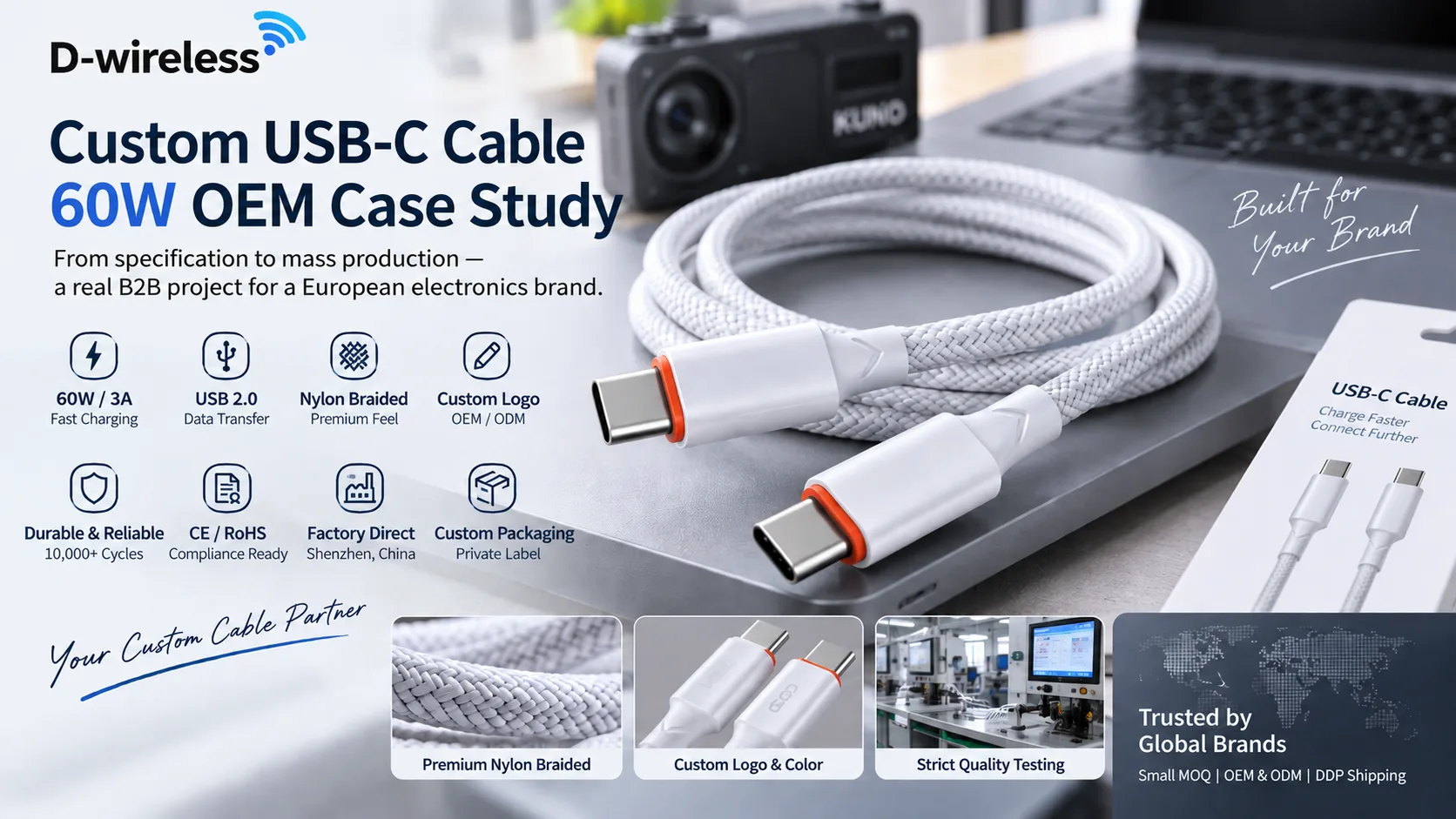
After evaluating available designs, the customer selected the following white braided 60W USB-C cable as the basis for further development.

Actual 60W braided USB-C cable design selected during this European OEM sourcing project.
This case study explains why the customer selected this cable and what other electronics brands should evaluate when sourcing a custom USB-C cable.
Project at a Glance
| Item | Project Requirement |
|---|---|
| Buyer | European electronics company |
| Application | Cable bundled with electronic device |
| Cable | USB-C to USB-C |
| Preferred Length | 1.0 m |
| Alternative Lengths | 0.8 m / 1.2 m |
| Charging | Up to 60W / 3A |
| Data | USB 2.0 |
| Alternative | 100W / 5A E-Marker |
| Construction | Premium braided |
| Key Requirement | Soft hand-feel and low memory |
| Colors | Black / off-white / custom |
| Branding | Custom connector logo |
| Target Market | Europe |
| Mechanical Tests | 10,000 plug cycles / 5,000 bend cycles at 60° / 10 kgf |
| Logistics | Delivery to OEM assembly factory in Shenzhen |
Why Did the Customer Choose a 60W Braided USB-C Cable?
The selected cable combines the customer’s required charging specification with a physical design suitable for a premium electronic product.
Its visible characteristics include:
- USB-C connectors at both ends
- White braided outer jacket
- Clean connector housings
- Extended molded strain relief
- Branding area on the connector
- 60W charging identification
- Minimalist consumer-electronics appearance
The customer was not sourcing a standalone promotional charging cable.
It was sourcing an accessory that would become part of the finished product.
That distinction matters.
A cable can meet the basic electrical requirement but still be unsuitable for a premium device if it feels excessively stiff, retains strong bends after unpacking, has inconsistent braid quality or uses a connector design that does not match the rest of the product.
For this reason, the project evaluated both electrical specifications and physical user experience.
Is a 60W USB-C Cable Enough for an Electronic Device?
Yes. A 60W USB-C cable can be sufficient for many smartphones, tablets, portable electronics and compact electronic devices when the device does not require more than the cable’s supported power.
For appropriate USB Power Delivery applications, a USB-C cable designed for up to 3A can support power up to 60W under the relevant voltage and current conditions.
For OEM sourcing, however, the objective should not be to choose the highest wattage available.
The correct question is:
What power does the actual device require?
If the bundled device does not require more than 60W, increasing the cable specification solely to display a larger wattage number may increase BOM cost without improving the device’s charging speed.
That is why this project uses 60W / 3A as the baseline while evaluating a higher-current version separately.
D-WIRELESS supplies different OEM USB-C cable solutions for electronic devices, retail brands and private-label projects.
60W vs 100W USB-C Cable: What Is the Difference?
The key difference is current capability. A typical 60W USB-C PD cable can operate up to 3A, while a USB-C cable designed for 5A operation requires appropriate electronic marking and can support higher-power applications under the relevant USB PD conditions.
| Feature | 60W / 3A Cable | 100W / 5A Cable |
|---|---|---|
| Connector | USB-C to USB-C | USB-C to USB-C |
| Current | Up to 3A | Up to 5A |
| Power | Up to 60W | Up to 100W |
| E-Marker for 5A | No | Yes |
| USB 2.0 Data Option | Yes | Yes |
| Braided Option | Yes | Yes |
| OEM Branding | Yes | Yes |
| Typical Use | Phones, tablets, accessories, compact devices | Laptops and higher-power devices |
| Relative BOM Cost | Lower | Higher |
When Should an OEM Buyer Choose 60W?
A 60W/3A cable is a logical choice when:
- The device requires less than 60W
- USB 2.0 data is sufficient
- BOM efficiency is important
- The cable is mainly designed for the bundled product
- 5A charging is unnecessary
When Should an OEM Buyer Consider 100W?
A 100W/5A solution may make more sense when:
- Higher-current charging is required
- Laptop compatibility is important
- The cable will be reused with higher-power devices
- Broader charging compatibility is part of the product positioning
D-WIRELESS currently offers OEM cable options covering 60W, 100W and higher-power configurations, so the power specification can be selected according to the actual application rather than treating one wattage as suitable for every project.
Does a 100W USB-C Cable Need an E-Marker?
Yes. A USB-C cable intended for 5A operation requires appropriate electronic marking so compatible devices can identify the cable’s current-carrying capability.
An E-Marker is an electronic component integrated into an electronically marked USB-C cable assembly.
This creates an important distinction:
3A USB-C cable → up to 60W under appropriate USB PD conditions
5A USB-C cable → higher-current operation → E-Marker required
For OEM buyers, an E-Marker should therefore be treated as part of the cable’s technical specification rather than simply a marketing feature.
When evaluating a 5A cable, buyers can ask their supplier to identify the E-Marker solution and confirm that the cable construction matches the claimed electrical specification.
Does USB-C Automatically Mean High-Speed Data?
No. USB-C describes the connector type. It does not automatically mean USB 3.x, USB4 or another specific data-transfer speed.
Charging and data should be specified separately.
For this project, the requirement is:
60W charging + USB 2.0 data
USB 2.0 can be sufficient for applications such as:
- Device configuration
- Firmware updates
- Synchronization
- Basic file transfer
- Device communication
If the device does not need high-bandwidth data transfer, specifying a more complex data standard can increase cost without creating meaningful user value.
OEM Sourcing Rule
Always define these separately in your RFQ:
Power: 60W / 100W / 240W / other
Current: 3A / 5A
Data: USB 2.0 / USB 3.x / USB4 / charge-only
Connector: USB-C does not determine all three.
What Makes a Braided USB-C Cable Feel Premium?
A premium braided USB-C cable should combine consistent braid construction, suitable flexibility, comfortable hand-feel, low cable memory, durable connector construction and effective strain relief.
D-WIRELESS supports multiple cable-jacket materials across OEM projects, including PVC, TPE, PU, nylon braided and other braided/cloth constructions.
For this particular project, the customer emphasized three physical characteristics.
1. Soft Hand-Feel
The cable should be comfortable to handle rather than excessively hard or rigid.
This matters because the cable will be included with the customer’s main electronic product.
2. Low Cable Memory
Low cable memory reduces the tendency of a cable to remain tightly curved after being stored in packaging.
A cable may work perfectly but still create a poor first impression if it remains sharply bent when the customer opens the product.
3. Braided Exterior
A braided jacket can create a more premium tactile and visual appearance while providing additional resistance to everyday surface abrasion.
For OEM projects, these characteristics should be evaluated using physical samples rather than catalogue images alone.
Why Does Strain Relief Matter on a USB-C Cable?
Strain relief reduces concentrated mechanical stress where the flexible cable meets the rigid connector housing.
This is one of the areas most frequently subjected to repeated movement during normal cable use.
The selected cable uses an extended molded transition between the connector housing and braided cable.
However, appearance alone does not prove mechanical durability.
That is why D-WIRELESS evaluates cable construction using mechanical testing, including bending and tensile testing as applicable to the product.
For this selected cable, the confirmed mechanical specifications include:
- 10,000 plug/unplug cycles
- 5,000 bending cycles at 60°
- 10 kgf breaking-force test
These measurable specifications provide a more useful basis for OEM evaluation than simply describing a cable as “durable.”
How Durable Is This 60W Braided USB-C Cable?
For this selected model, three mechanical tests are particularly relevant.
| Mechanical Test | Specification | What It Evaluates |
|---|---|---|
| Plug/Unplug Test | 10,000 cycles | Repeated USB-C connector insertion and removal |
| Bend Test | 5,000 cycles at 60° | Cable and strain-relief durability |
| Breaking-Force Test | 10 kgf | Mechanical strength of cable/connector assembly |
D-WIRELESS uses different mechanical and functional testing procedures during cable quality evaluation. Learn more about our quality control and testing process.
10,000-Cycle Plug/Unplug Test
The USB-C connector is evaluated for 10,000 insertion and removal cycles under the specified test method.
This helps evaluate connector durability under repeated use.
For a cable bundled with an electronic device, this is particularly relevant because the accessory may be connected and disconnected throughout the product’s service life.
5,000-Cycle 60° Bend Test
The cable undergoes 5,000 bending cycles at a 60° angle under the defined test conditions.
Repeated bending places stress on the cable-to-connector transition, making strain-relief construction particularly important.
10 kgf Breaking-Force Test
The cable is evaluated against a 10 kgf breaking-force specification according to the defined test method.
This test evaluates the mechanical strength of the cable and connector assembly under pulling force.
What Should OEM Buyers Ask?
Don’t ask only:
“Is your cable bend tested?”
Ask:
“How many cycles?”
“At what angle?”
“Under what load?”
“What is the pass/fail criterion?”
Specific test conditions make supplier comparisons much more meaningful.
What Other Tests Should an OEM USB-C Cable Undergo?
Mechanical durability is only one part of cable validation.
Depending on the project, evaluation can also include:
Electrical Performance
Testing can verify parameters such as:
- Voltage
- Current
- Power
- Resistance
- Voltage drop
Continuity and Data
For a cable that supports USB 2.0 data, the wiring and communication function should be checked rather than assuming that every charging cable also supports data.
Temperature
Temperature behavior can be monitored under electrical load to help identify excessive resistance or poor electrical connections.
Appearance
For customized projects, QC should also check:
- Cable color
- Braid consistency
- Connector finish
- Logo position
- Printing quality
- Cable length
- Packaging
D-WIRELESS maintains a dedicated quality-control section covering cable bending, tensile and other product testing, and the company states that it has more than 30 QC staff supporting product inspection.
Can This USB-C Cable Be Made in Custom Colors?
Yes. Depending on material availability, construction and MOQ, OEM braided USB-C cables can be developed in standard or customized colors.
The European customer requested:
Black
A versatile option for professional electronics.
Off-White
Suitable for minimalist and lifestyle-oriented products.
Custom Brand Color
Useful when the cable needs to coordinate with the device housing, packaging or corporate identity.
Custom color development can involve several separate components:
Braided yarn + strain relief + connector housing + branding
These components may use different materials.
Even when they target the same Pantone reference, the final appearance can differ because of material texture and light reflection.
For that reason, we recommend approving a physical color sample before mass production.
Can a Logo Be Added to the USB-C Connector?
Yes. D-WIRELESS supports custom branding and packaging for OEM cable projects, and the selected cable provides a visible connector-housing area that can be used for brand identification.
Depending on the housing material and project requirements, possible methods can include:
| Branding Method | Appearance | Suitable For |
|---|---|---|
| Printing | Clear logo/text | Standard OEM projects |
| Laser Marking | Subtle, premium | Compatible surfaces |
| UV Printing | Multi-color | More complex branding |
| Molded/Embossed Logo | Integrated | Higher-volume project |
There is also an important difference between:
Existing connector housing + custom logo
and
Fully customized connector housing
Using an existing housing usually reduces:
- Tooling requirements
- Development cost
- Sampling time
A completely customized connector housing may require:
- Industrial design
- Engineering review
- Tooling
- Mold development
- Sample validation
- Higher MOQ
D-WIRELESS also operates its own packaging and logo-printing capability and supports ID and packaging design for OEM projects.
What Compliance Documents Matter for a European USB-C Cable Project?
European electronics buyers commonly request RoHS and REACH documentation for cable projects, depending on the product configuration and final compliance requirements.
This customer’s RFQ specifically requested:
- RoHS
- REACH
- CE/FCC declarations if applicable
- USB-related information where applicable
- E-Marker information for the higher-current version
D-WIRELESS maintains a certificate section covering ISO 9001:2015 and various product-level reports/certifications across its mobile-accessories portfolio.
However, OEM buyers should avoid assuming that every certificate shown by a manufacturer automatically applies to every cable model.
For a specific project, always verify:
- Which document applies to the exact product?
- Is the model/material covered?
- Is the report still relevant to the current construction?
- Does the final product require additional compliance work?
For this project, the relevant product-level documents should be confirmed against the final approved cable configuration before mass production.
How Does D-WIRELESS Develop a Custom USB-C Cable?
D-WIRELESS’s existing OEM workflow covers specification confirmation, sample development, logo and packaging design, customized materials, mass production, delivery and after-sales support.
For a custom cable project, we recommend the following workflow.
Step 1 — Application Review
Tell us what device the cable will be used with.
Step 2 — Technical Specification
Confirm:
- Connector
- Power
- Current
- Data
- Length
Step 3 — Construction
Confirm:
- Cable jacket
- Braided material
- Flexibility
- Connector housing
- Strain relief
Step 4 — Appearance
Confirm:
- Standard/custom color
- Pantone reference
- Logo
- Logo position
- Packaging
Step 5 — Sample Evaluation
Evaluate:
- Appearance
- Hand-feel
- Flexibility
- Device compatibility
- Charging
- Data
Step 6 — Testing
Confirm the required electrical and mechanical tests.
Step 7 — Golden Sample Approval
Freeze the final specification before mass production.
Step 8 — Mass Production and QC
Produce against the approved specification and golden sample.
Step 9 — Delivery
Ship internationally or deliver to the customer’s nominated assembly factory in China.
Why Is the Golden Sample Important?
A golden sample is the approved physical reference used to help maintain consistency between development and mass production.
A common OEM sourcing problem occurs when:
The first sample is good, but the mass-production product is different.
This can involve:
- Different color
- Different braid
- Different flexibility
- Logo-position changes
- Connector finish
- Packaging differences
For a customized cable, the final specification and approved sample should therefore be controlled together.
The objective is not simply to make one good sample.
The objective is to reproduce the approved product consistently across:
1,000 → 5,000 → 10,000 → 30,000 pieces.
What Is the MOQ for a Custom USB-C Cable?
USB-C cable MOQ depends on the level of customization rather than one universal quantity.
An existing cable with a standard color and custom logo is different from a project requiring:
- Custom braid color
- Pantone matching
- New connector housing
- New mold
- Special internal construction
- Custom retail packaging
For this project, the customer requested pricing at:
1,000 pcs
5,000 pcs
10,000 pcs
30,000 pcs
This is a good RFQ method because it allows both buyer and supplier to understand how scale affects cost.
D-WIRELESS’s broader OEM positioning includes small-quantity customization support, while the final MOQ for a specific cable should be confirmed according to its construction and customization requirements.
What Determines the Price of a Custom USB-C Cable?
Custom USB-C cable pricing depends on the complete specification, not just length and wattage.
Important cost variables include:
- Copper/conductor construction
- Cable length
- Cable diameter
- Charging current
- Data specification
- E-Marker
- Braided material
- Connector housing
- Strain relief
- Custom color
- Logo process
- Packaging
- Testing
- Order quantity
This explains why two 1-meter USB-C cables that look nearly identical can have different prices.
Better RFQ
Instead of asking:
“Price for 1m Type-C cable?”
send:
“USB-C to USB-C, 1m, 60W/3A, USB 2.0, braided, custom logo, off-white, 5,000 pcs.”
The second inquiry gives the manufacturer enough information to recommend and quote a much more relevant solution.
Factory or Trading Company: What Should a Buyer Really Verify?
For OEM sourcing, understanding who controls engineering, customization, QC and production is more useful than relying only on the label “factory.”
D-WIRELESS is based in Shenzhen and positions itself as an OEM mobile-accessories manufacturer. Its website describes capabilities including R&D, mold/injection resources, logo and packaging customization, design support and QC.
For cable projects, buyers should ask:
- Who confirms the cable specification?
- Who controls material selection?
- Who produces/customizes the connector?
- Who controls logo printing?
- Who performs QC?
- Who handles failures?
- Who owns the approved specification?
- Who coordinates mass production?
This gives a much clearer picture of supplier capability.
Can D-WIRELESS Deliver the Cable Directly to a Shenzhen OEM Factory?
Yes. For an electronics project assembled in China, a cable supplier can deliver finished cables directly to the customer’s nominated OEM assembly or packing factory under the agreed logistics arrangement.
That is exactly the supply-chain structure requested in this project.
[IMAGE 8 – SHENZHEN OEM SUPPLY-CHAIN INFOGRAPHIC]
The planned workflow is:
D-WIRELESS / Cable Production
↓
Cable Inspection
↓
Domestic Delivery in Shenzhen
↓
Customer’s OEM Assembly Factory
↓
Electronic Device + USB-C Cable + Packaging
↓
Finished Product
↓
European Market
Before delivery, the parties should confirm:
- Receiving address
- Contact person
- Required arrival date
- PO/reference number
- Carton quantity
- Carton dimensions
- Gross/net weight
- Carton markings
- Receiving requirements
- Local freight charge
This can simplify supply-chain consolidation when several Chinese suppliers contribute parts or accessories to one finished electronic product.
What Can Other Electronics Brands Learn From This Project?
This sourcing case highlights five practical lessons.
1. Start With the Device
Don’t choose the cable before understanding the actual device power and data requirements.
2. Separate Power, Current and Data
“USB-C” alone is not a complete specification.
Define:
Connector + Power + Current + Data
3. Evaluate Physical Experience
For bundled accessories, flexibility, cable memory, braid and connector finish matter.
4. Ask for Measurable Testing
“Durable cable” is vague.
10,000 plug cycles + 5,000 bends at 60° + 10 kgf is measurable.
5. Plan the Supply Chain Early
If the cable will be delivered to another OEM factory for final packing, define domestic logistics, carton markings and receiving requirements before mass production.
Custom USB-C Cable RFQ Checklist
If you are sourcing a USB-C cable for an electronic device, send your manufacturer the following information.
| Category | Information to Provide |
|---|---|
| Application | What device will use the cable? |
| Connector | USB-C to USB-C / other |
| Power | 60W / 100W / other |
| Current | 3A / 5A |
| Data | USB 2.0 / USB 3.x / USB4 / charge-only |
| Length | 0.8m / 1m / 1.2m / custom |
| Jacket | Nylon braided / TPE / silicone / other |
| Color | Standard / Pantone |
| Logo | Artwork + preferred process |
| Packaging | Bulk / retail / custom |
| Quantity | Sample + first order + annual forecast |
| Testing | Electrical / bend / tensile / plug / temperature |
| Compliance | Destination-market requirements |
| Logistics | EXW / FOB / domestic China delivery / other |
The more complete the RFQ, the easier it is for suppliers to recommend an appropriate cable rather than simply quote the cheapest existing model.
Frequently Asked Questions About Custom 60W Braided USB-C Cables
What Is a 60W USB-C Cable?
A 60W USB-C cable is designed to support power delivery up to 60 watts under appropriate voltage/current and USB PD conditions. A USB-C cable designed for up to 3A can support up to 60W under the relevant operating conditions.
Does a 60W USB-C Cable Need an E-Marker?
A standard USB-C cable operating up to 3A does not require an E-Marker solely for standard 3A operation. USB-C cables intended for 5A operation require appropriate electronic marking.
What Is the Difference Between a 60W and 100W USB-C Cable?
A typical 60W USB-C PD cable can operate up to 3A, while a 100W cable designed for 5A operation requires an E-Marker and appropriate internal construction.
Is a 100W Cable Better Than a 60W Cable?
Not automatically. If the connected device requires less than 60W, using a 100W cable may not increase charging speed. The appropriate specification depends on the device and intended use.
Can a 60W USB-C Cable Transfer Data?
Yes, if data conductors are included. The cable in this sourcing project is specified for both 60W charging and USB 2.0 data.
Does USB-C Mean USB 3.0?
No. USB-C describes the connector. Data capability must be specified separately.
What Does Low-Memory Cable Mean?
A low-memory cable has less tendency to retain tight bends or coils after storage, which can improve handling and the unboxing experience.
Can a Braided USB-C Cable Be Customized in Pantone Colors?
Custom colors can be possible depending on materials, construction and MOQ. Physical color-sample approval is recommended because braid, housing and strain-relief materials may display color differently.
Can I Put My Logo on a USB-C Cable?
Yes. Depending on the connector construction, OEM branding can include printing, laser marking, UV printing or molded/embossed branding.
How Many Bend Cycles Does This Cable Support in Testing?
The selected cable is specified for a 5,000-cycle bend test at 60° under the defined test method.
How Many Plug/Unplug Cycles Is This USB-C Cable Tested For?
The selected model is specified for 10,000 plug/unplug cycles under the defined test method.
What Is the Breaking-Force Specification?
The selected cable has a 10 kgf breaking-force test specification under the defined test method.
What Compliance Documents Should European Buyers Request?
Depending on the final product and application, buyers may request relevant RoHS and REACH documentation and other applicable technical or compliance information.
Can D-WIRELESS Deliver Cables to Another Factory in Shenzhen?
Yes. For projects assembled or packed in China, domestic delivery to a nominated OEM factory can be arranged according to the agreed address, carton information and logistics terms.
What Is the MOQ for a Custom USB-C Cable?
MOQ depends on the cable construction and customization. Logo-only projects, custom colors, special materials and new connector tooling can have different MOQ requirements.
Why Source Custom USB-C Cables From D-WIRELESS?
D-WIRELESS is a Shenzhen-based OEM mobile-accessories manufacturer supporting customized data-cable projects for brands, distributors and electronics companies.
Our cable and OEM capabilities include:
- USB-C to USB-C cables
- 60W, 100W and higher-power cable options
- USB 2.0 and other cable configurations
- Nylon braided and other cable materials
- Custom lengths
- Custom colors
- OEM connector branding
- Custom packaging
- Sample development
- Product testing and QC
- China domestic delivery
- Export support
D-WIRELESS operates under an ISO 9001:2015 quality-management system and supports OEM projects with design, logo/packaging customization, sales project management and QC resources.
For us, a custom cable project should not start with:
“Which cable is cheapest?”
It should start with:
“What cable specification is right for your device, market and customer?”
Need a Custom USB-C Cable for Your Electronic Product?
Developing a USB-C cable for a new electronic device, retail product, or private-label project?
Tell us what you need. D-WIRELESS can evaluate your application and recommend a suitable existing model or OEM/ODM solution.
Not sure about the exact cable specification? That’s fine. Tell us your device application, target charging power and estimated quantity, and our team can help you confirm the remaining details.