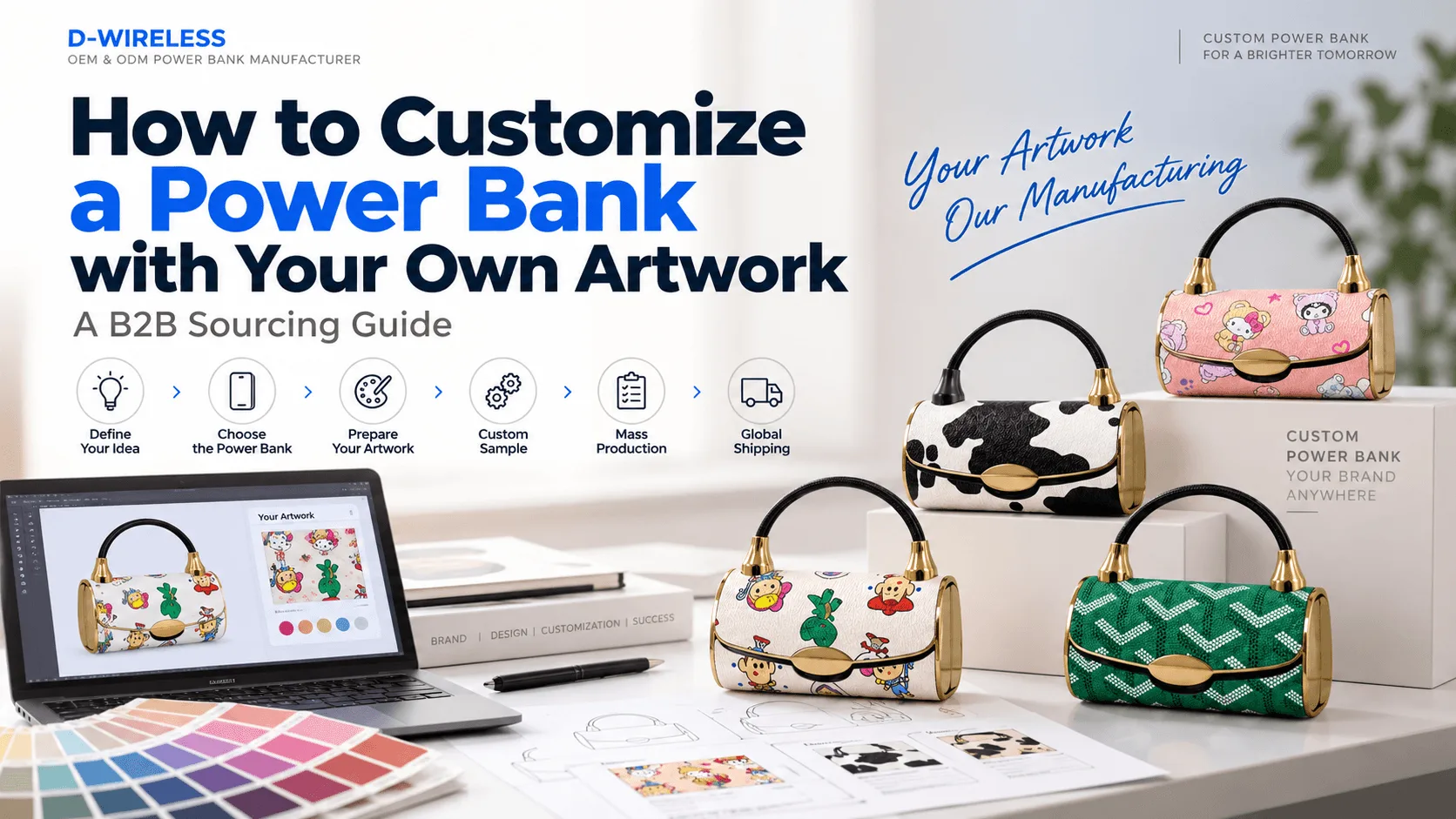
For brands, distributors, promotional gift companies, and retailers, customizing a power bank no longer means simply placing a small logo on a standard product.
With the right product structure and manufacturing process, buyers can customize artwork, full-surface patterns, colors, logos, packaging, charging specifications, and other design elements to create a power bank that fits a retail collection, corporate identity, promotional campaign, or private-label brand.
But how do you turn an artwork file into a real mass-produced power bank?
This B2B sourcing guide explains the process—from choosing the right power bank and preparing artwork to sampling, mass production, quality inspection, and international shipping.
What Is a Custom Power Bank?
A custom power bank is a portable battery charger whose appearance, branding, packaging, or product specifications are modified according to a buyer’s requirements.
Depending on the product and order requirements, customization can include:
- Logo printing
- Full-surface artwork
- Custom patterns
- Pantone-matched colors
- Housing materials
- Battery capacity
- Charging specifications
- Built-in cables
- Custom packaging
- Private-label branding
For simple promotional projects, customization may only involve adding a company logo.
For retail and private-label projects, however, buyers may require a more complete OEM power bank solution involving the product appearance, artwork, packaging, and branding system.
This is why it is important to distinguish between basic logo printing and deeper product customization.
Can You Put Your Own Artwork on a Power Bank?
Yes. Depending on the housing material and product design, customer-supplied artwork, illustrations, patterns, photographs, brand graphics, and promotional designs can be applied to a power bank.
However, not every power bank provides the same customization possibilities.
A conventional power bank may only provide a small flat area for logo printing.
Products designed around customization can provide a much larger printable or decorative surface.
For example, a handbag-style power bank with a leather-finish exterior can be developed with different:
Patterns · Illustrations · Colors · Brand Graphics · Logos · Themed Designs
This makes the product itself part of the visual identity rather than simply adding a logo to an existing electronic accessory.
Logo Printing vs. Full-Surface Artwork: What’s the Difference?
This is one of the first decisions a B2B buyer should make.
| Customization | Logo Printing | Full-Surface Artwork |
|---|---|---|
| Custom Logo | Yes | Yes |
| Multiple Colors | Possible | Yes |
| Complex Illustration | Limited | Better suited |
| Large Design Area | Limited | Yes |
| Pattern Customization | Limited | Yes |
| Brand Storytelling | Basic | Strong |
| Promotional Use | Excellent | Excellent |
| Retail Collection | Suitable | Highly Suitable |
| Private Label | Suitable | Highly Suitable |
If the objective is simply to distribute branded charging accessories at an event, a logo may be sufficient.
If the objective is to create a recognizable retail product or branded collection, full-surface artwork can provide significantly more creative flexibility.
Step 1: Define Your Custom Power Bank Project
Before contacting a manufacturer, define the basic sourcing requirements.
At minimum, prepare the following information:
Product Type
What type of power bank are you looking for?
For example:
- Magnetic power bank
- Mini power bank
- Handbag power bank
- Built-in cable power bank
- Laptop power bank
- Promotional power bank
- Eco-friendly power bank
Battery Capacity
Common requirements may include:
5,000mAh
10,000mAh
20,000mAh or higher
The appropriate capacity depends on the product format and intended application.
Charging Requirements
Determine whether you require:
- Standard USB charging
- USB-C
- PD fast charging
- Built-in cable
- Wireless charging
- Magnetic wireless charging
Quantity
Provide an estimated order quantity.
This helps the manufacturer evaluate the appropriate customization process, production cost, packaging solution, and quotation.
Target Market
Tell the supplier where the products will be sold or distributed.
For example:
United States / European Union / United Kingdom / Middle East / South America
This information can affect certification, labeling, packaging, and transportation requirements.
Step 2: Choose a Power Bank Suitable for Artwork Customization
This step is often overlooked.
Not every attractive power bank is suitable for complex artwork.
Before selecting a model, consider:
Printable Surface Area
Is there enough space for your artwork?
Housing Material
ABS, PC, aluminum, bamboo, leather-style surfaces, and other materials require different customization methods.
Product Shape
Flat surfaces are generally easier to print than complex curves.
However, specially designed products can offer more distinctive customization opportunities.
Existing Product Structure
Check whether buttons, ports, screens, magnets, cables, or decorative components interfere with the artwork.
Intended Application
A corporate gift project may prioritize logo visibility.
A fashion or lifestyle brand may prioritize full-surface graphics.
A retailer may prioritize packaging and shelf appearance.
The right product should be selected around the final commercial objective, not just the unit price.
Step 3: Prepare Your Artwork Files
Once the product is selected, the manufacturer will need your artwork.
What File Format Should You Send?
For professional customization, vector artwork is usually preferred when available.
Common formats include:
AI
EPS
PDF
SVG
High-resolution raster files such as PSD, PNG, or TIFF may also be usable depending on the printing process.
For logos, vector files are generally preferable because they can be resized without losing quality.
What Information Should Be Included?
Your artwork package should ideally include:
- Logo file
- Pattern or illustration
- Brand colors
- Pantone references if applicable
- Positioning requirements
- Packaging artwork
- Special finish requirements
If your design includes text, make sure fonts are either supplied or converted appropriately for production artwork.
Step 4: Select the Right Customization Method
Different designs require different production methods.
D-WIRELESS commonly works with several branding and surface customization options depending on the product.
Silk Screen Printing
Suitable for:
Simple logos and limited-color graphics
Advantages:
- Cost-effective
- Clear branding
- Suitable for promotional orders
- Good for simple designs
UV Printing
Suitable for:
Full-color logos, graphics, illustrations, and complex artwork
Advantages:
- Multiple colors
- Detailed graphics
- Greater creative flexibility
- Suitable for retail-oriented designs
Laser Engraving
Suitable primarily for:
Metal housings and premium minimalist branding
Advantages:
- Durable
- Professional appearance
- No printed ink layer
- Particularly suitable for aluminum products
LED Logo
Suitable for selected power bank structures where illuminated branding is supported.
It can be useful for:
- Premium corporate gifts
- Technology brands
- Promotional projects
- Brand activation campaigns
Full-Surface Pattern Customization
For products specifically designed to support larger decorative surfaces, artwork can become a major part of the product appearance.
This is particularly useful for:
- Fashion brands
- Lifestyle brands
- Licensed merchandise
- Promotional campaigns
- Seasonal collections
- Private-label retail products
The correct method depends on the housing material, artwork complexity, quantity, durability requirement, and desired appearance.
Step 5: Create the Artwork Layout
After receiving your artwork, the manufacturer prepares the design according to the actual product dimensions and printable area.
This stage is important because a design that looks good on a computer screen may need adjustments before it works on a physical product.
Typical considerations include:
Logo Position
Should the logo be centered, offset, repeated, or integrated into the pattern?
Artwork Cropping
Some artwork may need to extend beyond the visible print area.
Ports and Buttons
Important design elements should not be positioned over USB ports, buttons, screens, or other functional areas.
Curved Edges
Artwork near curves and edges may require additional adjustment.
Color Matching
Brand colors should be clearly specified.
The buyer should approve the final layout before sample production begins.
Step 6: Make a Custom Sample
For custom artwork projects, sample approval is particularly important.
A digital mockup can help confirm the approximate appearance, but it cannot fully represent:
- Actual material texture
- Printed color
- Surface gloss
- Artwork alignment
- Product feel
- Logo appearance
- Packaging quality
For this reason, buyers developing retail or branded products should consider approving a physical sample before mass production.
What Should You Check on the Sample?
Do not only check whether the logo is present.
Evaluate the complete product.
Artwork
Check:
- Position
- Scale
- Color
- Sharpness
- Pattern alignment
Product Appearance
Check:
- Surface finish
- Material
- Color
- Assembly
- Cosmetic quality
Charging Performance
Verify the relevant charging functions and interfaces.
Packaging
If packaging is customized, confirm:
- Product name
- Logo
- Barcode
- Specifications
- Warnings
- Artwork
- Printing quality
Only after these details are approved should the project proceed to mass production.
Step 7: Confirm the Golden Sample
For B2B OEM projects, the approved sample should become the reference for production.
This helps both buyer and manufacturer establish a common quality standard.
The approved reference may cover:
Product Appearance + Artwork + Color + Logo + Function + Packaging
When possible, keep clear records of the approved version.
This reduces misunderstandings during mass production.
Step 8: Start Mass Production
Once the sample, specifications, packaging, quantity, and commercial terms are confirmed, the project can move into production.
Depending on the customization requirements, production may involve:
Material Preparation
↓
Housing Production
↓
Artwork / Logo Customization
↓
Electronic Assembly
↓
Battery Assembly
↓
Functional Testing
↓
Final Assembly
↓
Appearance Inspection
↓
Packaging
The exact production sequence varies according to the product.
Step 9: Quality Control for Custom Power Banks
Artwork customization should never replace electrical quality control.
A customized power bank is still a battery-powered electronic product.
Quality inspection should therefore cover both:
Cosmetic Quality
Including:
- Printing
- Logo position
- Color consistency
- Surface scratches
- Assembly gaps
- Packaging
Functional Quality
Including:
- Charging input
- Charging output
- USB-C function
- Fast-charging performance
- Battery operation
- Display function where applicable
- Built-in cable function where applicable
- Wireless charging where applicable
The inspection criteria should be confirmed according to the specific product and project requirements.
Step 10: Confirm Compliance and Shipping Documents
Power banks contain lithium batteries, so international transportation requires more attention than ordinary promotional products.
Depending on the product, destination, transportation method, and buyer requirements, relevant compliance and shipping documentation may be required.
For lithium battery products, buyers commonly discuss documentation such as:
UN38.3
MSDS
Air/Sea Transportation Reports
Market-specific product compliance requirements should also be confirmed for the destination country.
Do not assume that one certification package automatically covers every product, market, or shipment.
Ask the supplier which documents apply to the specific model you are purchasing.
Step 11: Customize the Packaging
Packaging is especially important for private-label and retail projects.
Common options include:
Standard Paper Box
Suitable for cost-sensitive projects.
Custom Printed Box
Suitable for branded retail products.
Gift Packaging
Suitable for corporate gifting and premium promotional projects.
Eco-Friendly Packaging
Suitable for sustainability-oriented campaigns and brands.
Packaging can potentially include:
Brand Logo
Product Artwork
Product Specifications
Barcode
QR Code
User Instructions
Compliance Information
For a true private-label project, product and packaging should normally be designed as one system.
How a Custom Handbag Power Bank Can Turn Artwork into a Product
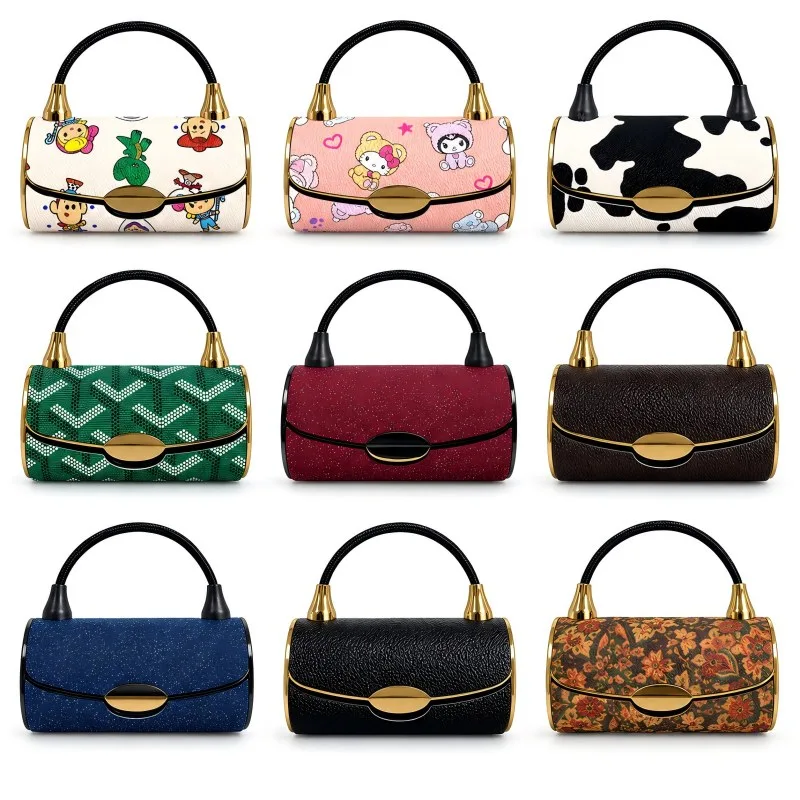
One example of artwork-focused customization is the D-WIRELESS 10,000mAh Custom Handbag Power Bank.
Instead of using a conventional rectangular housing with a small logo area, this model uses a handbag-inspired design with a larger decorative surface.
Buyers can develop different:
Artwork · Patterns · Colors · Logos · Packaging
around the same basic product platform.
Its current specifications include:
| Specification | Details |
|---|---|
| Battery Capacity | 10,000mAh |
| Fast Charging | Up to 22.5W |
| USB-C Input | 5V/2A, 9V/2A, 12V/1.67A — 20W Max |
| USB-C Output | 5V/3A, 9V/2.22A, 12V/1.67A — 22.5W Max |
| Material | ABS + Leather |
| Product Size | 99.1 × 38.5 × 101 mm |
| Product Weight | 180g |
| Package Size | 140 × 79 × 44 mm |
| Artwork Customization | Available |
| Color & Pattern Customization | Available |
| OEM / ODM | Available |
This type of product is particularly relevant when the buyer wants the artwork itself to become one of the main selling points.
Who Buys Custom Artwork Power Banks?
Custom artwork power banks can serve several B2B markets.
Promotional Gift Companies
Instead of supplying another standard logo-printed charger, promotional companies can offer customers a product built around a campaign theme or visual identity.
Retailers
Different artwork and color combinations can turn one product platform into several retail SKUs.
Fashion & Lifestyle Brands
Artwork can coordinate the charging accessory with existing product collections.
Corporate Gift Buyers
A customized charger can combine practical everyday use with company branding.
Beauty Brands
Fashion-oriented power bank formats can work particularly well with beauty and lifestyle campaigns.
Licensed Merchandise Companies
Authorized character or entertainment artwork can potentially be developed into merchandise, subject to intellectual-property authorization and manufacturing feasibility.
E-Commerce Brands
Private-label sellers can use differentiated artwork and packaging to avoid competing solely on generic product specifications.
How Much Does a Custom Power Bank Cost?
There is no single price for a customized power bank.
For B2B sourcing, the final unit cost can depend on:
Power Bank Model
A simple promotional model and a premium fast-charging model have different base costs.
Battery Capacity
Capacity affects battery and product cost.
Charging Specification
Fast-charging components can affect pricing.
Order Quantity
Higher quantities can change manufacturing economics.
Customization Method
A simple one-color logo and complex full-surface artwork do not necessarily have the same cost.
Packaging
Standard packaging and custom retail packaging have different costs.
Certification Requirements
Project-specific testing or documentation may affect overall project cost.
Shipping Method
Lithium battery shipping requirements differ from ordinary goods.
For an accurate quotation, provide the manufacturer with the actual project requirements rather than asking only:
“How much is a custom power bank?”
A better RFQ is:
Product model + quantity + destination country + artwork + packaging requirement + required delivery date
OEM vs. ODM: Which Do You Need?
These terms are often used loosely, but buyers should understand the practical difference.
OEM Customization
You select an existing power bank model and customize elements such as:
Logo
Artwork
Color
Pattern
PackagingThis is generally the most straightforward route for brands that want faster development and lower project complexity.
ODM Development
The product itself requires deeper development.
This could involve:
- New industrial design
- New structure
- New functions
- Different electronic specifications
- Mold development
- Prototype development
If your main requirement is “I want my artwork on this existing power bank”, you probably need an OEM/private-label project rather than full ODM development.
What Should You Ask a Power Bank Manufacturer Before Ordering?
Before placing an OEM order, ask specific questions.
- Can this model support my artwork?
- What customization process will be used?
- What artwork format do you need?
- Can you produce a customized sample?
- What is the MOQ for this specific customization?
- What is the sample lead time?
- What is the mass-production lead time?
- Which charging protocols does the product support?
- Which compliance documents are available for this model?
- What quality tests are performed?
- Can you customize the packaging?
- What shipping options are available for lithium battery products?
A manufacturer should be able to answer these questions based on the specific project rather than giving only generic statements about OEM capability.
Frequently Asked Questions
Can I put my own picture on a power bank?
Yes, some power bank surfaces can support customer-supplied images, artwork, illustrations, or patterns. The suitable printing or customization method depends on the product material, surface structure, artwork, and quantity.
Can I customize the entire surface of a power bank?
Some models support much larger artwork areas than standard logo-printing zones. The exact printable area should be confirmed using the product template or artwork layout.
Can I use multiple colors in my design?
Yes, depending on the customization method. Full-color processes such as UV printing can support more complex graphics than simple one- or two-color logo printing.
Can you match my brand color?
Custom colors may be possible depending on the product, material, quantity, and manufacturing process. Pantone references are useful when discussing brand colors.
Can I make several patterns for the same power bank?
Potentially, yes. Using the same product platform with different artwork can be useful for developing a collection. MOQ and cost should be confirmed for each design or SKU.
Can I customize both the power bank and packaging?
Yes. OEM/private-label projects can combine product branding with customized retail or gift packaging.
Do I need toprovide a physical sample?
For customized retail or private-label projects, a physical sample is recommended because it allows the buyer to evaluate actual color, material texture, artwork position, charging performance, and packaging before mass production.
What information should I send for a quotation?
For a faster quotation, provide your estimated quantity, destination country, selected power bank model, artwork or logo, packaging requirements, and target delivery date.
Why Work with D-WIRELESS for Custom Power Bank Projects?
D-WIRELESS is a Shenzhen-based OEM/ODM mobile accessories manufacturer providing customized power bank solutions for distributors, brands, retailers, promotional gift companies, and other B2B buyers.
Our customization capabilities include:
Custom Artwork & Patterns
Develop different visual designs around suitable power bank models.Logo Customization
Options can include printing, laser engraving, UV printing, and other methods depending on the housing and project.Custom Colors
Develop product colors according to project requirements and manufacturing feasibility.Custom Packaging
Create private-label retail or promotional gift packaging.OEM & ODM Support
Choose an existing product for customization or discuss deeper product development requirements.Quality Control
Customized appearance and charging functions can be inspected according to confirmed project specifications.International Shipping Support
Shipping solutions for lithium battery products can be discussed according to destination and order requirements.From Artwork to Finished Power Bank
The basic B2B customization process can be summarized as:
Your Idea / Artwork
↓
Choose the Power Bank
↓
Confirm Specifications
↓
Artwork Layout
↓
Custom Sample
↓
Sample Approval
↓
Mass Production
↓
Quality Inspection
↓
Custom Packaging
↓
International Shipping
The most important point is to involve the manufacturer early enough in the design process.
A visually impressive artwork is only useful if it can be reproduced consistently on the selected product and still meet the project’s functional, quality, packaging, compliance, and budget.
Ready to Turn Your Artwork into a Power Bank?
If you already have a logo, pattern, illustration, or product concept, send D-WIRELESS your project requirements for evaluation.
For a faster OEM quotation, include:
1. Power Bank Type
2. Required Quantity
3. Destination Country
4. Logo / Artwork File
5. Packaging Requirements
6. Target Delivery DateSTART YOUR CUSTOM POWER BANK PROJECT